Eng Coffee Sips — What’s Jev?
1067 words, a 5-minute read.
What is Jev?
Jev is the first model from TypeSafe AI. It does not write text. A program sends it state plus a typed question, and it returns a typed answer with a probability attached: a choice from a list you define, a score, or a true-or-false likelihood. TypeSafe calls this a System One Model.
Input costs $0.042 per million tokens and output is free. TypeSafe states that responses take 70 to 500 milliseconds. Founder Diogo Almeida spent four and a half years at OpenAI and co-authored the InstructGPT paper.
( TypeSafe AI / TypeSafe docs / TechCrunch )
Why does it matter?
Much of the software that calls a language model wants a decision, not an encyclopedia of content: which queue?, is this spam?, approve or escalate? Jev is priced and timed for that. At the published rate a million tokens of input costs about four cents, and an answer arrives in under a second.
TypeSafe says that is 40 to 200 times faster than frontier models at a fraction of the cost.
( Vercel / TechCrunch / @amankhan )
What it can’t do
TypeSafe’s own documentation for jev-1.13 lists the weak spots. It reads instructions literally, counts and does arithmetic unreliably, compares dates and times poorly, struggles when the state it is given is large and mostly irrelevant, and is vulnerable to adversarial content. Its advice is to keep the arithmetic in code.
The answers have to be bounded and known up front, with at most 255 choices, and it cannot produce free text, code or a rationale. TypeSafe’s benchmark, relayed by Arize, has Jev at 68% accuracy against 73% for Opus 5. The company describes its zero-hallucination figure as not empirical: an answer cannot leave the schema, which is not the same as being right.
What people have built
-
A browser agent that found flights in seven seconds Gregor Zunic of Browser Use posted a browser agent driven by Jev finding flights in 7 seconds for $0.0039, with the video at normal speed. The figures are his own. The code is public as jev-ultrafast.
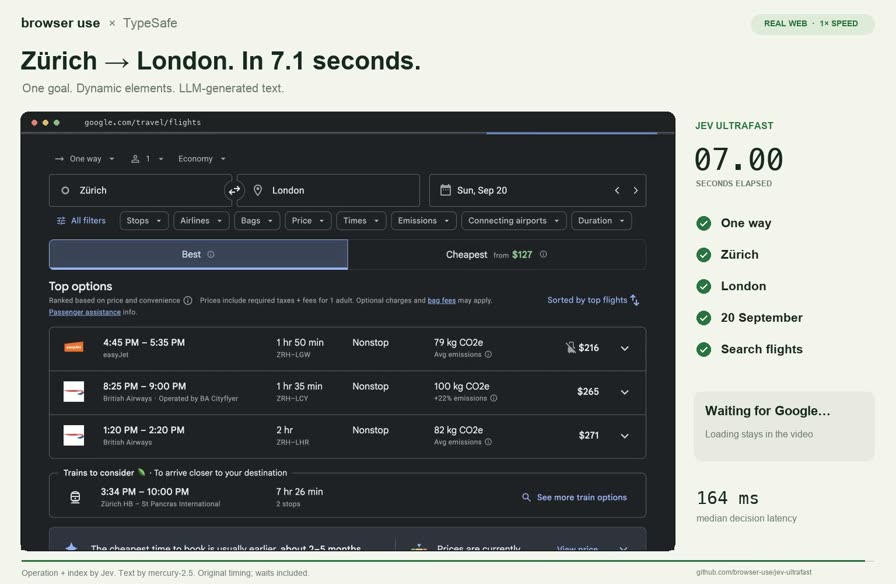
Frame from @gregpr07’s demo ( @gregpr07 )
-
A Postgres function that filters rows on a plain-English condition A developer posting as @iam_zachi wrote a PostgreSQL extension that adds a jev() function, so a query can filter on a condition such as people who could work from home, with no index and no embeddings. He reports 129 rows judged in about a second for $0.0009, and 6ms from cache on the second run.
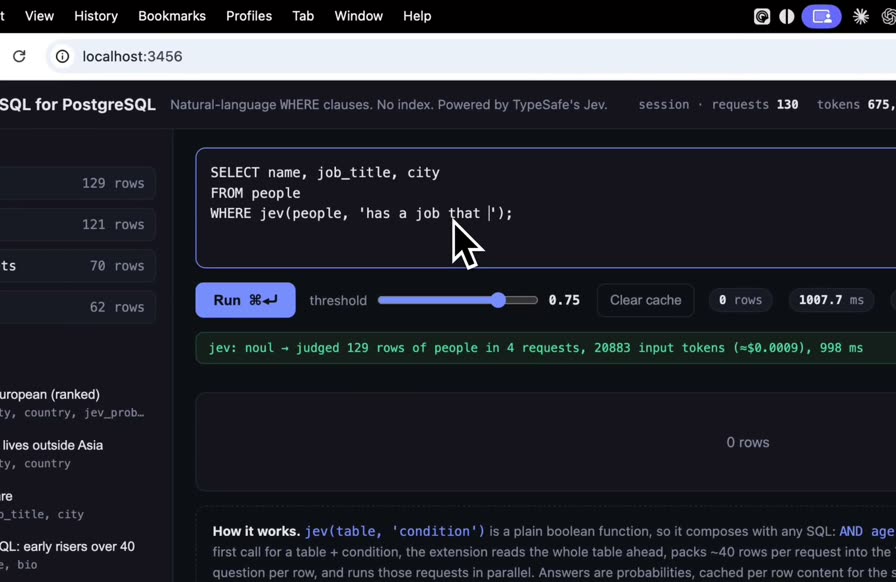
Frame from @iam_zachi’s demo ( @iam_zachi )
-
A trading bot that makes a call every 300-millisecond block Jarrod Watts open-sourced a bot that asks Jev for a buy or sell call on MON/USDC every 300ms Monad block and can place orders on Kuru’s on-chain order book. Without a private key it runs as a simulation against the real book, which is what his demo shows.
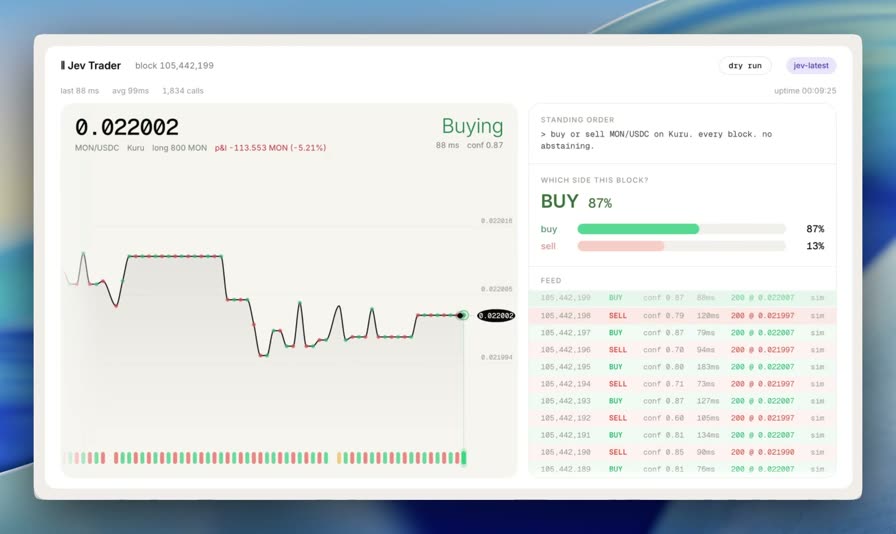
Frame from @jarrodwatts’s demo ( @jarrodwatts )
-
A design system restyled from one sentence Gonzalo Bilune, head of engineering at Aerolab, built a dashboard on shadcn/ui that Jev restyles from a one-sentence brief in about two seconds. It chooses from a catalog of 29 flags he wrote, more than a quadrillion combinations, and cannot invent a value outside it.

Frame from @biluneg’s demo ( @biluneg )
-
A text box that becomes an event card, a checklist or a bill splitter as you type Anish Gupta, a 21-year-old student, built Shapeshift, an open-source Next.js input that morphs into one of 19 cards as you type. A single Jev call answers 14 typed questions in parallel: which card, plus signals like video call or urgent. Dates, sums and units are parsed by deterministic code, and it falls back to a keyword classifier offline.
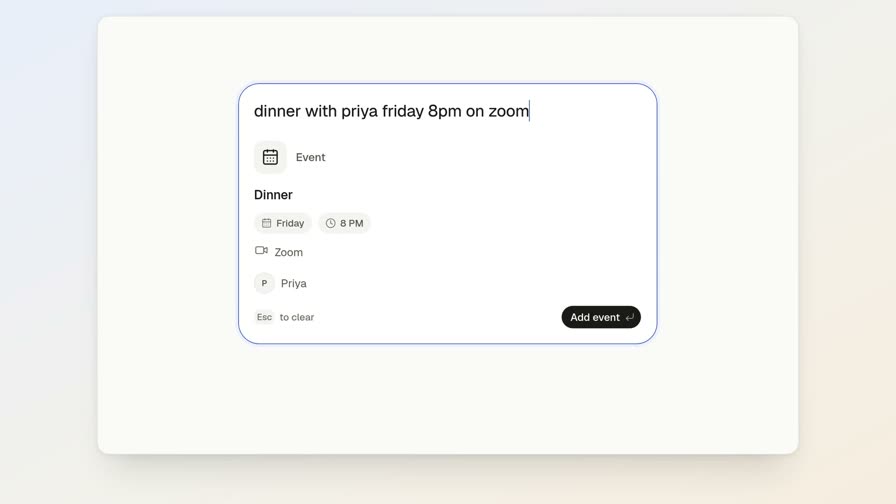
Frame from @anishfn’s demo ( @anishfn )
-
Matching 384 news stories to 15 brands in 25 seconds Elvis Sun ran 384 news items through Jev in 24.9 seconds to match stories to 15 brands, at a cost of $0.19. In the same time, by his count, Claude Opus 5 got through four. It is his own single run, for his own newsjack tool.

Frame from @elvissun’s demo ( @elvissun )
-
Matt DesLauriers renders Jev’s colour probabilities as you type Generative artist Matt DesLauriers typed phrases into a text box and had Jev score each against the 16 fixed colours of his Bitframes palette, drawing the weighted probabilities as a bar that reshapes on every keystroke: “tomato” goes red, “luigi” green, “blue screen of death” light blue. He calls it very cheap and fast, and a leap forward for new interfaces on language models.

Frame from @mattdesl’s demo ( @mattdesl )
-
Four Jevs playing Super Smash Bros. against each other Mau Baron had four Jev instances play a Super Smash Bros. Melee free-for-all, each choosing moves for its own character. Response times shown on screen run from 165 to 336 milliseconds. He has published no code.

Frame from @maubaron’s demo ( @maubaron )
-
A browser extension that stamps SLOP on your X feed as you scroll Robin Bilgil, founder of the ops-automation startup Whirl, built a browser extension that sends each post to Jev as it scrolls into view and overlays a red SLOP stamp with a percentage, or a small green “Not slop” badge, under it. The 19-second demo passed 760,000 views. No code is public; he says a Chrome release is coming.

Frame from @RBilgil’s demo ( @RBilgil )
-
Picking NFL bets from its own win probabilities Ethan Kam had Jev estimate win probabilities for a Sunday of NFL games, compared them with prices on Robinhood, and sized bets with the Kelly criterion. It found five bets and four won: $67.14 risked, $97 paid. That is one Sunday and five bets.
( @ethank_6 )
-
Drawing on a canvas by voice Jack Cheng posted a 39-second video captioned only “Jev is the future”, which a roundup of Jev demos describes as drawing on a canvas by voice. He has not published code or an account of how it works.
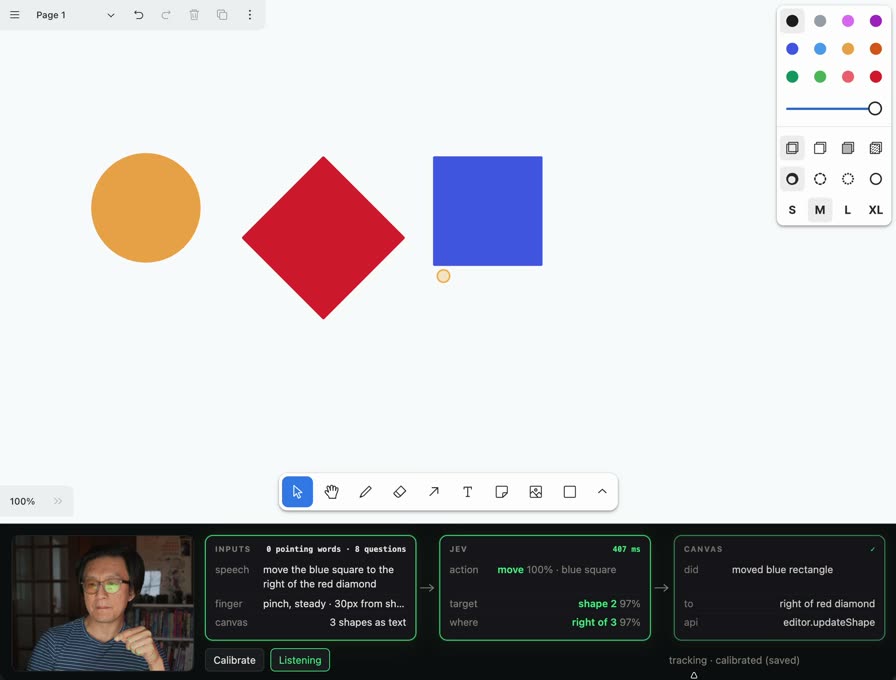
Frame from @jackcheng’s demo ( @jackcheng )
-
A blackjack card counter, and the pit boss that catches it A developer posting as Kevin built a blackjack table where one Jev counts cards and wins until a second Jev, playing pit boss, steps in. The video runs four minutes 43 seconds. There is no code.
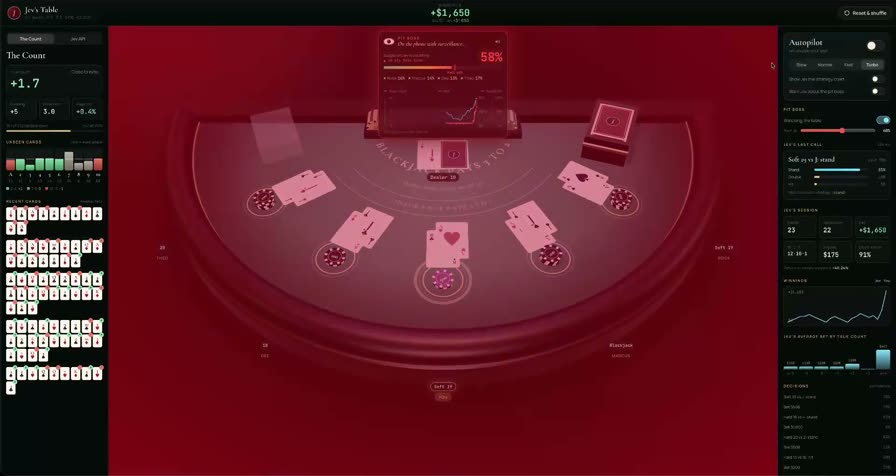
Frame from @Blueprint_Biz’s demo ( @Blueprint_Biz )
-
Scoring 700 sales leads in 40 seconds Roman, who builds the outreach product GojiberryAI, says Jev scored 700 leads and their outreach messages in 40 seconds for $0.09, flagging mismatches with a confidence score. The post is a demo of his own product and offers early access to it.

Frame from @romanbuildsaas’s demo ( @romanbuildsaas )
-
Ship with Jev catalogues more than 500 builds, with the cost and speed each author reported Ship with Jev is an independent directory of things built on Jev. It lists more than 500 builds in eight categories, each linked to its X post or repo with the author’s own cost and latency numbers.
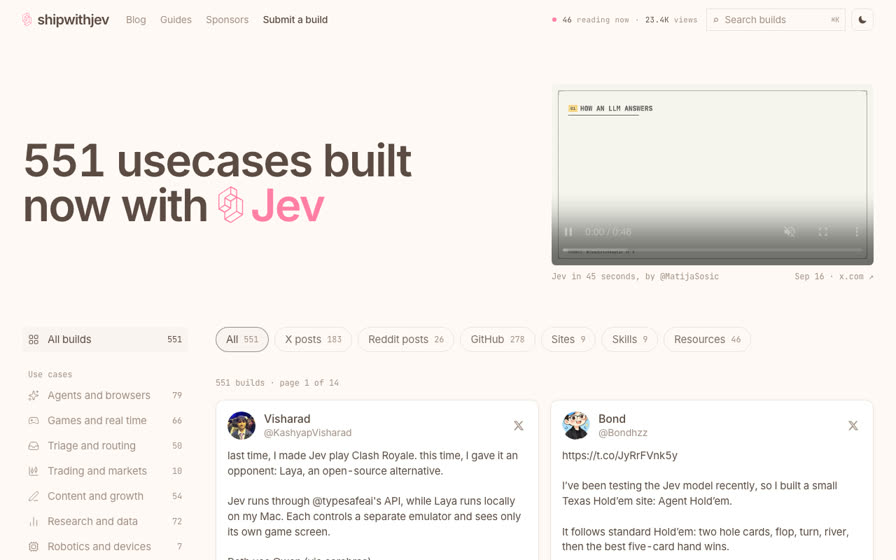
The site on September 23 ( Ship with Jev / @icantcodefyi )